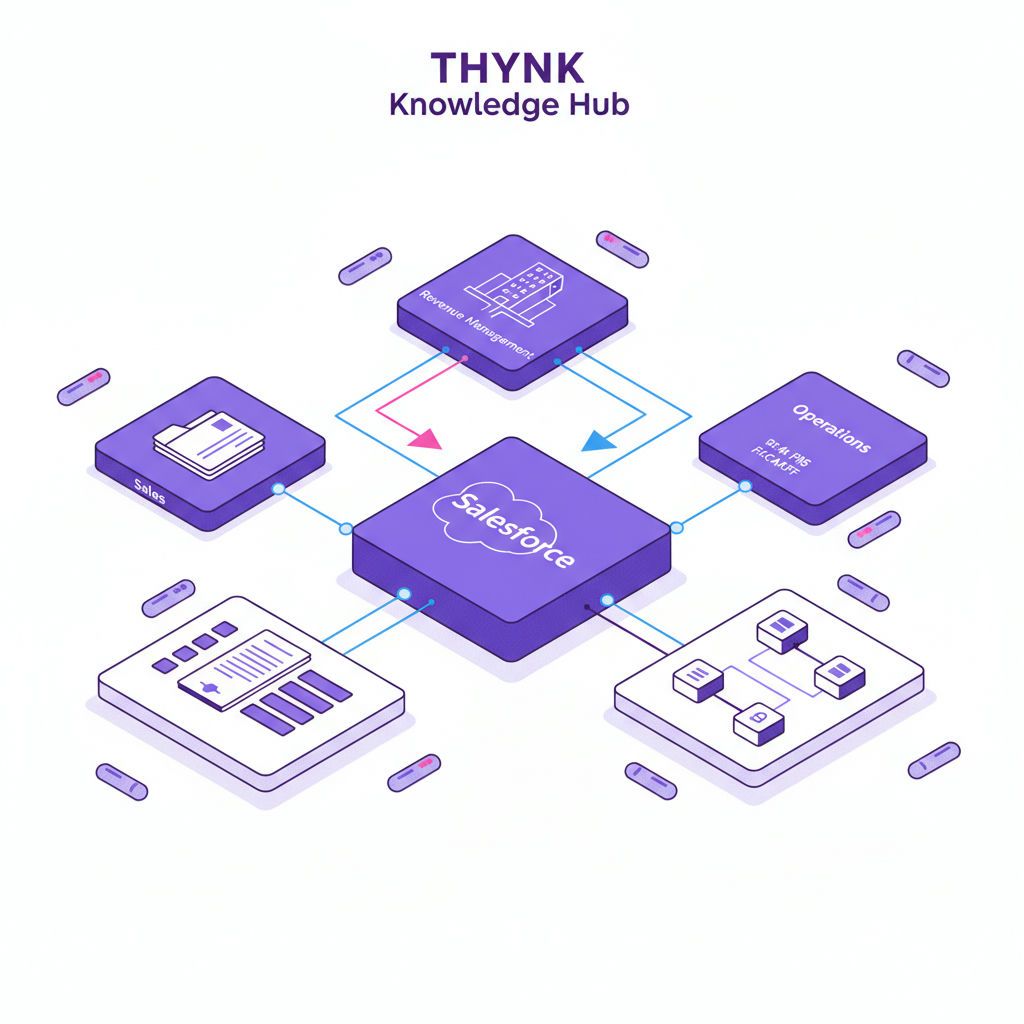
What Is Commercial Strategy in Hospitality?
Commercial strategy in hospitality is the unified alignment of sales, revenue management, marketing, and operations teams around a single profitability goal—maximizing Net Operating Income (NOI) while reducing dependency on high-commission channels. Unlike traditional siloed approaches where departments optimize in isolation, commercial strategy establishes shared KPIs anchored to revenue capture rate, direct booking percentage, and contribution margin.
Hotels implementing unified commercial strategies achieve revenue growth 1.9 percentage points higher and earnings growth 4.7 points above industry averages by replacing volume-chasing with data-driven, profitability-focused decision-making powered by hospitality CRM systems.
Why Commercial Strategy Matters: The Domino Effect on Your P&L
A few percentage points in revenue capture rate—the amount retained after commissions, distribution costs, and operational expenses—has an outsized impact on NOI, which directly drives hotel asset valuation. While Average Daily Rate (ADR) and guest-paid revenue reach new highs, hoteliers increasingly keep less due to rising OTA commissions, fragmented distribution, and operational inefficiencies.
Commercial strategy reverses this negative cascade by creating a single commercial operating model where every department contributes to the same profitability target. Instead of sales chasing group volume while revenue management focuses on transient ADR in isolation, unified teams align around Total RevPAR—including ancillary revenue—and work from a single source of truth in a Salesforce-native hospitality CRM.
This consolidated approach eliminates the data fragmentation that causes misalignment. When group sales, transient reservations, and account hierarchies live in one platform built on Salesforce, every stakeholder—from revenue managers to finance controllers—operates with the same guest profiles, corporate account structures, and real-time availability data.
Four Pillars of a Winning Commercial Strategy
1. Keep It Simple: Evolution, Not Revolution
Commercial strategy is not about replacing existing processes—it's about connecting them. Every team needs a clearly defined North Star (e.g., NOI, direct booking percentage, or revenue capture rate) and the tools to contribute to it.
A hospitality CRM consolidates guest data, group pipelines, and transient demand in one platform, eliminating disconnected spreadsheets and siloed systems. Thynk's Salesforce-native architecture provides this foundation through its integrated capability stack spanning Group CRS, B2B CRM, GSO (Group Sales Optimization), and Analytics—all working from the same data model.
Action: Establish a unified dashboard showing how sales, marketing, and revenue decisions collectively impact NOI. Use native PMS integrations (Opera, Mews, Stayntouch, Protel) to ensure finance, reservations, and CRM maintain data parity without manual reconciliation.
2. Make NOI Your Primary KPI
Net Operating Income—calculated as gross operating income plus other income, minus operating costs—is the ultimate measure of hotel profitability and the basis for asset valuation. Every incremental dollar of revenue captured through direct bookings, upsells, or lower-commission channels flows directly to NOI.
Action: Replace legacy volume metrics ("total rooms booked" or "RFP count") with revenue capture rate, direct booking percentage, and contribution margin by channel. Use PACE reporting to track group and transient performance against profitability targets, not just booking volume.
When evaluating group business, consider the full profitability picture: a 100-room group at 15% discount with high attrition may deliver less NOI than 80 direct transient bookings at full rate with food & beverage upsells. Thynk's room-block management capabilities enable real-time tracking of pickup patterns to support these profitability assessments.
3. Adopt a Commercial-First Mindset
A commercial-first mindset breaks down departmental silos and creates "three-lane highways" where sales, marketing, revenue, and operations collaborate on shared objectives. This requires a data-driven culture where teams act on unified insights—guest lifetime value, channel ROI, lead scoring, and account-hierarchy roll-ups—rather than working from fragmented reports.
Action: Implement a hospitality CRM that unifies guest profiles, corporate accounts, group pipelines, and transient bookings. Deploy AI email parsing to convert inbound RFPs into structured Opportunities, automatically scored and routed to the right sales representative or property.
Thynk's Agentforce integration enables AI agents to triage, qualify, and draft responses for group inquiries, accelerating sales velocity while freeing revenue managers and sales directors to focus on high-value negotiations and account expansion.
4. Target Your Most Profitable Opportunities
Volume is not profitability. Commercial strategy prioritizes optimal opportunity over maximum volume by evaluating each booking against contribution margin, pickup history, and ancillary spend potential.
Action: Use lead scoring and distribution to rank inbound group inquiries by profitability indicators. Build e-proposals that highlight multi-property availability and package management options, and track room-block pickup in real time to adjust strategy before attrition penalties impact NOI.
For repeat guests, deploy direct booking campaigns via email and loyalty channels, informed by identity resolution in your CRM, to reclaim OTA bookers and shift distribution mix toward higher-margin channels.
The Role of Salesforce-Native Architecture in Commercial Strategy
Commercial strategy execution depends on clean data and unified workflows. A Salesforce-native hospitality platform ensures:
- Single source of truth for guest profiles, corporate accounts, group pipelines, and transient demand across the entire capability stack
- Account-hierarchy roll-up so sales reps and revenue managers see parent-child relationships (corporate head office → regional branches → individual bookers)
- PMS parity for finance: folios, deposits, and BEOs sync in real time through e-BEO workflows, eliminating manual reconciliation
- Einstein Trust Layer governs AI interactions, preventing agents from hallucinating rates, availability, or guest data
- Agentforce agents automate RFP triage, qualification, and drafting, accelerating sales cycles without adding headcount
This architecture is particularly critical when managing MICE business, where complex multi-stakeholder negotiations, space management requirements, and F&B coordination demand seamless data flow between sales, operations, and finance teams.
How to Implement Commercial Strategy in Your Property
Step 1: Audit Your Current KPIs
Are you measuring volume or profitability? Replace vanity metrics with NOI-linked indicators:
- Revenue capture rate (net revenue after commissions/costs)
- Direct booking percentage (bookings outside OTA channels)
- Contribution margin by channel (profitability per distribution source)
- Account expansion rate (growth within existing corporate accounts)
Step 2: Unify Your Data
Consolidate guest profiles, group pipelines, and transient demand in a hospitality CRM with native PMS integrations. This single source of truth enables:
- Real-time availability management across group and transient inventory through Group CRS capabilities
- Automated lead distribution based on property, segment, and rep capacity
- Unified sales forecasting that incorporates group pace, transient demand, and historical patterns
For properties comparing platforms, explore Thynk alternatives to understand how Salesforce-native architecture differs from legacy point solutions or loosely integrated systems.
Step 3: Deploy AI Agents
Use Agentforce to triage RFPs, score leads, and draft proposals—accelerating sales cycles and reducing manual work. AI agents built on the Einstein Trust Layer can:
- Parse inbound group inquiries and create structured Opportunities with accurate data capture
- Qualify leads against ideal customer profiles and route high-value prospects to senior sales staff using GSO workflows
- Generate initial proposal drafts incorporating rate strategies, availability constraints, and upsell opportunities
- Answer routine guest questions and booking inquiries, freeing human agents for complex negotiations
Learn more about AI agents in hospitality and how governed AI differs from generic chatbots.
Step 4: Cross-Train Teams
Establish shared dashboards and regular commercial review meetings where sales, revenue, and marketing evaluate performance against NOI targets. Create cross-functional accountability:
- Sales teams report on pipeline quality and contribution margin, not just booking count
- Revenue managers assess channel mix and direct booking rates alongside ADR
- Marketing teams track campaign ROI and guest acquisition cost by segment
- Operations teams monitor fulfillment costs and ancillary revenue capture through e-BEO execution
Key Takeaways
- Commercial strategy aligns sales, revenue, marketing, and operations around maximizing NOI through unified KPIs and data-driven decision-making.
- Revenue capture rate—not just ADR or occupancy—drives profitability and hotel asset value.
- OTA commissions erode margins; commercial strategy prioritizes direct bookings and high-margin channels.
- A hospitality CRM built on Salesforce provides the single source of truth, account hierarchy, and PMS parity required to execute commercial strategy at scale.
- AI-powered tools (Agentforce, Einstein Trust Layer, email parsing) automate low-value tasks, freeing teams to focus on high-ROI opportunities and account expansion.
Next Steps
For hoteliers ready to move from siloed operations to a unified commercial operating model, a Salesforce-native hospitality CRM delivers the clean data, governed AI, and sales automation required to capture more revenue, reduce OTA dependency, and drive long-term profitability.
Explore these resources:
- How to choose a hospitality CRM
- Thynk vs. legacy MICE platforms
- Understanding account hierarchy in hotel CRM
- AI agents and crawlers in hospitality
Start by consolidating your guest data, establishing NOI-linked KPIs, and deploying AI agents to accelerate group sales velocity—the foundation of sustainable commercial strategy execution.